

It looks effortless when watching the top professionals strike their irons and sounds so pure as a huge divot flies down the fairway. But how do they do it?
The ease to which hot shots sustain their irons makes they way too much work, makes the smooth fluidity in their swings accentuated by the notable shorts of Clover being cut off with perfect overgrown perms. But, it does not mean the skill required is obligatory to only top notch professionals like the course players they usually show on TV. There is outstanding determination and years put other honing their sword polishing the ultimate universe of the fundamentals of the game.
To perform at that level, you need to pay attention to specific issues like your grip, stance, and alignment. The grip needs to offer enough control to allow the clubface to meet the ball squarely at impact. Your stance should be steady and balanced, with your weight evenly distributed to allow your body to rotate naturally during the swing. Moreover, active drills aimed at ball position and follow-through will help you to identify that magical spot where all the elements come together. With focused practice, these techniques will help you appreciate how consistently professionals achieve that sought after sound and impressive distance, and quite simply, change your game.
Well, there are a myriad of reasons why puring your irons can be so difficult, but I want to focus on 3 main ones to help explain what causes the challenge.
When thinking about purposefully using your irons, there are many things that may affect how you do on the course. Although, there are three primary reasons that tend to stand out the most and serve as a common mistake for many golfers. Understanding them may be pivotal in realizing your potential and enhancing your playing style with the irons. To start, working on stance and alignment is notoriously problematic for many golfers. Poorly built aimbal systems easily result in inefficient engagement with the golf ball, variable clubface angle, and subsequent erratic shot departuers. Having a sound setup greatly bolsters striking consistency, which enables you to trust your swing.
Your swing path is perhaps just as important as the stance. Many golfers become too obsessed with perfecting every detail that they simply disregard the fundamentals; this often results in either an inside-out swing or an over-the-top move that makes clean contact very difficult. An efficient swing liberates your motion so that you can achieve a square clubface at impact. Improving focus on rhythm, tempo, and a consistent swing path will allow you to make solid strikes time after time in no time at all. Most often, golfers will not try to commit to the shot mentally. Like many sports, golf requires mental commitment through visualization and positive thinking; your swing is sure to suffer if your mind is cluttered with doubt or distraction. Improving your stance, addressing your swing path, and adjusting your mental approach will help any golfer improve precision and confidence when striking their irons.
1. Concept
Overview of Concept training reveals that it is well defined for any area of focus. Skill acquisition can be enhanced through sport-specific mental imagery. With any given mental model, there is a potential for great outcomes, but if predictions or plans go wrong, many things can go wrong. Visualization techniques are very thorough and powerful, but lack precision creates frustration. Your mind is powerful; it controls precise movements as well as how you approach the given task. Incorrect mental cues lead to effort that activates muscle waste. The body is reflexively trying to optimize responses as defined through the mind. If mental cues are vague or poorly defined, performance is negatively disrupted.
You are getting ready for a significant shot and, as usual, are mentally rehearsing it. Your thoughts feel organized, but reality indicates that your thought process does not match the technique you are trying to achieve. Most likely, you will perform the movement that golf trainers call “auto-pilot.” In golf, for example, self-doubt and a continuously critical inner voice can thwart the mindless execution that results in successful swings that flow smoothly. Each step is fluid and decisive. The steps executed in your mind are quick and the result is brilliant. Wonders or devastation can result from the projection you paint in your mind, thus cherishing accurate thinking of actions you intend to perform step by step is crucial. Focus on the outcome. In reality, it brings mental clarity when practice time comes – backend is the work, then practice is the guided flow.
When addressing an iron shot, you notice that some beginners like to try lifting the golf ball “up and off” the ground. This tendency originates from the thinking that you need to actively assist in lifting the ball’s flight with the clubface. This tendency is more common than you think and it results in more of a scooping action as opposed to a clean strike. The first step to correcting this misconception is changing the mindset of how to strike the ball. If your swing is accompanied by a heavy divot that begins before the golf ball, then you are hitting the golf ball in the wrong sequence. The correct sequence is hitting the ball followed by a shallow divot. This will guarantee a clean strike, more power, and the ideal height and distance for your shot.
Remarks such as “I didn’t get under that one” depict an incorrect idea for most people. The concept of ‘getting under the ball’ sometimes leads to attempts to scoop it rather than using a more productive angle of attack from above. As you may remember, an effective iron shot means the ball is hit and immediately followed by the ground. Your divot starts after the ball, indicating you struck the ball as intended. Prioritize hitting down on the ball and both the flight of the ball and your consistency will improve. By adopting this guideline, your scores on the course are bound to improve together with your iron play.
This example clearly shows a large number of golfers suffering from a significant lack of understanding of what needs to be done to play the shot successfully.
Many people at any level of proficiency may grapple with particular tantamount principles that allow them successful shots at a golf course. Put simply, shot execution is attaching a golf ball to the golfer’s club and swinging it in a precise angle and speed such that the ball lands on a specific location. Perhaps, a golfer with boastful claims of being a seasoned player can go as far as stating that the his swing is what enables him to propel the ball to extreme distances. In actual fact, golf is just as much emotional and cognitive as it is a combination of words, movements, training, repetitiveness and sometimes even luck.
In addition, a good number of players tend to make the situation more difficult than it really is because they think there is some complicated choreography they have to go through to get the result they want. Most of the time, however, the most uncomplicated solution is the best. Try not to stand up to the ball before you have completed a simple check of what is required of you for the particular shot. If you simplify the task into more manageable parts, like aiming, stance, and the follow-through, you will devise a better plan that addresses the particular difficulties posed by the course. Comprehending the execution of shots deeply will improve your performance in the game and more importantly, your enjoyment of it.
Know how the loft helps produce the height we want on the shot. Our goal is to get it moving forward, hopefully toward the target.
In the case where a shot requires some angle, it is best to ask why this extra height is needed. The loft of a club is to help the ball get off the groud so that it can rise to a height that enables it to go beyond some obstacles while also landing gently on the green. As a player, not only do you have to make sure that the ball will have some altitude, but also that the ball is moving forward. You must not forget that there has to be a balance between elevation and momentum toward the desired position. Picture the route you want to take; the loft will give you the height, and you will ensure the distance.
Tune in on your posture and the swing mechanics as you prepare for the shot so you use the correct amount of loft. Ensure proper ball placement in relation to your stance and that the clubface is square to the intended target line. It is important during the execution of the swing that the upward motion of the club combines effortlessly with forward movement. This would allow you to take advantage of the loft and propel the ball forward toward the pin. While the loft will be striving to help the ball gain height, remember that your role is to aim that altitude toward the hole so that your chances of success increase.
Most of the divot will be behind the golf ball, and this is possible while the club head is still moving downward as you make contact with the ball. The centered hit produces that delightful noise and results in a pure strike.
Improving your golf swing requires adequate knowledge of the impact mechanics, one of which is understanding where the majority of the divot occurs. The divot will mostly occur after the ball is hit. In simpler words, the club must be coming down towards the ball when you make contact with it. If you strike the ball while maintaining the club’s downward angle, you will not only ensure a cleaner strike, but also experience that satisfying feeling of a well-struck shot.
Striking the ball in the center of the clubface also elevates one’s level outstandingly. Every single golfer would agree that achieving the so-called “pure strike” delivers a very special sound that goes beyond just the beauty of a sound. Purity of the quoted strike signifies that the energy transfer between the club and the ball was precise. Best results in accuracy and distance are achieved when the player combines hitting the ball at the center of the clubface while swinging it downwards, creating that overwhelming sense of satisfaction after every shot. Practice these fundamentals, and you’re bound to master the art of the perfect golf swing.
This mental picture helps you master the mechanics of your motions to be near those tour professionals!
When you step out on the course with an exact clear mental image of the swing or the putting stroke you wish to execute, you are not just playing a game but carrying out a powerful simulation that inches you closer to the professional level. This type of imagery fills every aspect that needs correction and acts as some sort of scaffolding which simplifies intricacies like the grip and even the follow-through. Concentrating on this mental image allows you to establish a benchmark in performance well beyond just the physical repetition. The chances are that every time you play a round or practice, you are no longer relying solely on reflexive actions; rather, you are fortifying a very specific and predefined cycle of movements you want to embody.
You engage in your mental exercises so that each swing and shot becomes more intentional. Instead of relying on past experiences or pure instinct, you are now leveraging what drives professionals. It strengthens your confidence and enhances your focus, allowing you to cut through the subtleties of the game easily. The more you perfect this mental tactic, the more fluid your movements will be, and the better your connection with the golf ball will get—bringing you closer to the tour pros you admire. Utilize this practice mental tool and greatly improve your game.
2. “Open Club-Face“
The club face is one of the biggest factors that determines the direction a golf ball will start to travel. This also connects ‘faults’ 2 and 3 very closely together.
You also need to focus on the clubface angle during your swing and how it affects your game because it really matters. The impact motion is affected by the angle of the clubface relative to where the ball will be, so right-angled clubface leads to right ball 90% of the time. For hitting straighter shots or hitting certain areas of the course, positioning the clubface is hugely important.
Understanding the correlation between clubface positioning and common swing faults is very important. Mistakes made with the grip or even the stance tend to inconsistent clubface angles at impact resulting in erratic strikes. For example, an insufficient grip tends to either shut the clubface too much or keep it too open resulting in both stroked and sliced shots. Effectively correcting these “mistakes” highlights the need for a grip and stance that provides balance on the clubface angle to promote consistency. When paid attention together, not only you are correcting the direction of ball flight, but also the mechanism of swing at all levels for accuracy, reliability, and enjoyment on the game.
Golfers often need to focus on hitting the sweet spot but while it is tempting, striking through the center means the club face tends to open.
While playing golf, one of the important aspects that tend to affect your shot is the angle of the clubface in relation to the swing path. If the clubface “opens” during the golf swing, it means that it is tilted away from the target line at impact. Typically, this results in a slice or a push, and your ball will not travel straight. In order to counter this misalignment, you will need to make adjustments in your swing to subconsciously square the face of the club for impact. This could be an adjustment to your timing, stance, and even the angle of your follow through. These adjustments can result in inconsistencies in your game.
To help resolve the problems caused by an open clubface and sharpen your overall accuracy, make sure that your grip and stance are set up correctly before taking the club back. A stronger grip will help close the clubface more naturally during the swing arc. Moreover, try to be mindful of your takeaway and make sure the clubhead on the proper path to prevent excessive opening of the clubface. Remember that consistent practice and drills aimed at a square clubface at impact will help you build habits so that there is less need to compensate during the swing. In any case, the focus is a repeatable swing that strikes the ball solidly to boost accuracy.
An inactive lower body, subpar shaft lean at impact, and a poor downswing sequence are all common issues arising from the latter. All these contribute to the club “bottoming” out too early.
Your performance in golf can be heavily impacted by the mechanics of your swing, especially in the downswing section. If your lower body is inactive or disengaged, then it may cause your downswing to be unbalanced and not properly sequenced. It is crucial to remember that during the change from backswing to downswing is where force and precision are achieved. An uncoordinated sluggish lower half will cause you to “bottom out” early, or in other words, the clubface will make impact with the ground before the ball, resulting in poor contact, and it will throw off your timing and rhythm.
Moreover, problems like your shaft leaning too much on impact can make the issue worse. At impact, we want the shaft leaning slightly forward to help with getting the best strike and flight. If your lower body posture is working against you, it may make it harder for you to achieve the desired shaft angle during impact resulting in inconsistency. Whether it is slicing the ball or hitting it fat, all these faults stem from the inability to control body coordination. To maximize improvement, concentrate on engaging the lower body in the downswing and maintaining its dominant role in the motion to facilitate a more explosive and athletic swing movement sequence.
The upper portion of a golfer’s swing is frequently marked by suboptimal wrist positions, and this is a widespread concern among golfers.
Poor wrist angles at the top of the swing are a common problem, and many golfers battle this issue which can heavily impact performance on the golf course. When the wrists are incorrectly positioned, it can lead to inconsistent swing paths which may cause numerous mishits or wildly erratic shots. The proper wrist angle establishes a solid bond between the arms and club which allows for an easier, more controlled and powerful downswing. If your wrists are too bent or not aligned properly, generating necessary speed and accuracy becomes a challenge while downswinging.
This issue can be solved by working on grip and wrist alignment during practice. Ensure that the clubface is parallel to your forearm to help prevent the club from rising too high, promoting a flat or slightly extended wrist at the top. This will help shape the swing while leading to stronger and more reliable impacts with the ball. Drills emphasizing precise wrist angle retention when making contact with the ball will help forge the correct muscle memory. Improving on this oft-ignored element in your swing will help golfers gain better control of their performance and achieve a more consistent game, a goal for almost every golfer.
Because it is very difficult to support a good downswing sequence from here, it is a great position to check the mirror or a video. From here I will always appear over the top and stiff to the right elbow as well as the knee, and a good way to see me is through the elbow and wrist connection and how it trails to the hip.
The question arises, however, what happens to the lead wrist over the top in the finish of the swing. I assume this is penetrating too aggressive. Also, I wonder whether the trend for big golf and mechanic props also plays a role in it. Why is every wrist cupped everywhere open as in backhand of tennis? This suggests there will always be a flatter rather than fuller travel posture stemming from falling line.
Regularly checking your wrist placement will prevent this from happening. Assessment through a mirror or self-recordings can provide a lot of valuable information with regards to how your top swing positions affect your lead wrist. Determining whether the wrist is too cupped or the clubface is open can greatly help your strike pattern and swing consistency. So, practice makes perfect indeed holds true, but practicing the right way makes it much better. Cupping your wrist and practicing that simple check during practice will give you great results on the course.
Try matching the clubface to your leading arm or turning it a shade stronger at the top of the backswing. Your body’s range of motion will greatly improve and will reduce the need to compensate which makes it easier to strike the ball with a bit of downward force.

Achieving a more “neutral” lead wrist position at the apex of the backswing mitigates significant deficiencies in your swing mechanics. Neutral positions are usually more stable, therefore less movement is required to maintain or return it to that position.
In this instance, a neutral or slight cupped position lead wrist is less likely to be overly cupped or bowed, allowing for more controlled rotational opportunities relative to the player’s lead arm. This places the club face in the path of the lead arm which creates a streamlined controlled pathway for the club head during the pull down. A controlled closed face position acts like a neutral hinge, providing a stable platform to enable the player to rotate their body through the hit. Ensuring a position minimizes unwanted sideways and rotational movements that could cause erratic contact with the ball.
In addition, a neutral lead position improves the accuracy of the angle of the club head meeting the ball. The club head rotation during transition from backswing apex to impact needs to remain near parallel to the spine throughout the height of rotation therefore, staying neutral or slightly cupped will ensure the arms fall into position on the downswing. A pinch strike on the bottom quarter or lower third of the golf club promotes firm compression of the golf ball while remaining within optimal vertical alignment for propulsion. Primarily through the upper body, dominating arm movements through the impact routine leads to erratic balance, but tighter rhythm improves overall foot coordination. Balanced and rhythmic strokes strike the ball within a limited window of variation yielding the ability to move during the swing without thought, something typically achievable only by instinct.

This correlates flawlessly with our last fault.
When thinking about this last fault, consider the reflections you’ve made across your life, as well as how they intersect with your lived experiences and perceptions. This is not merely an intellectual endeavor; it requires action in your setting. It does not matter whether you are diagnosing these faults in your work environment, social circles, or in broader contexts; recognizing the existence of these faults is the first step that can lead to actual transformation. As you think about this final point, also consider how it challenges you to rethink established frameworks and take constructive actions towards these matters. In so doing, you enhance yourself and others to handle better these complexities of such faults.
3. Hanging Back

This is one of the most frequently occurring ‘swing faults’ we encounter as coaches and it is essentially “hanging back” or excessively loading the left side at impact. As we noted in this case, your club face assists a great deal with that weight shift.
As a coach, one of the most frequent swing faults I personally observe is the displacement of weight at impact. More often than not, players tend to “hang back,” leaving too much weight on their trailing side. This imbalance impacts your shot quality and overall performance. When a golfer’s body lingers anchored on the trail side, they will not be able to transfer energy efficiently through the swing. Instead of the sought after fluid and powerful follow through, there is the struggle to maintain what little rhythm, tempo and consistency is left over. The result? A multitude of missed shots and maximum frustration on the course.
ition, the alignment of your club face strongly determines how you transfer weight over your body. It either helps or hinders how you transfer weight to your target in the initial phases of your swing. If you tend to close or open the club face too much, it will hinder weight shift and lead to poor contact and strike inconsistency. You can minimize these tendencies with better grip and stance in relation to the club face. Aim for a balanced golf swing where your weight moves from the back, trail leg, smoothly through to the front, lead leg. This will help enhance your impact and accuracy. Resolving this issue will help improve confidence while playing on the course.
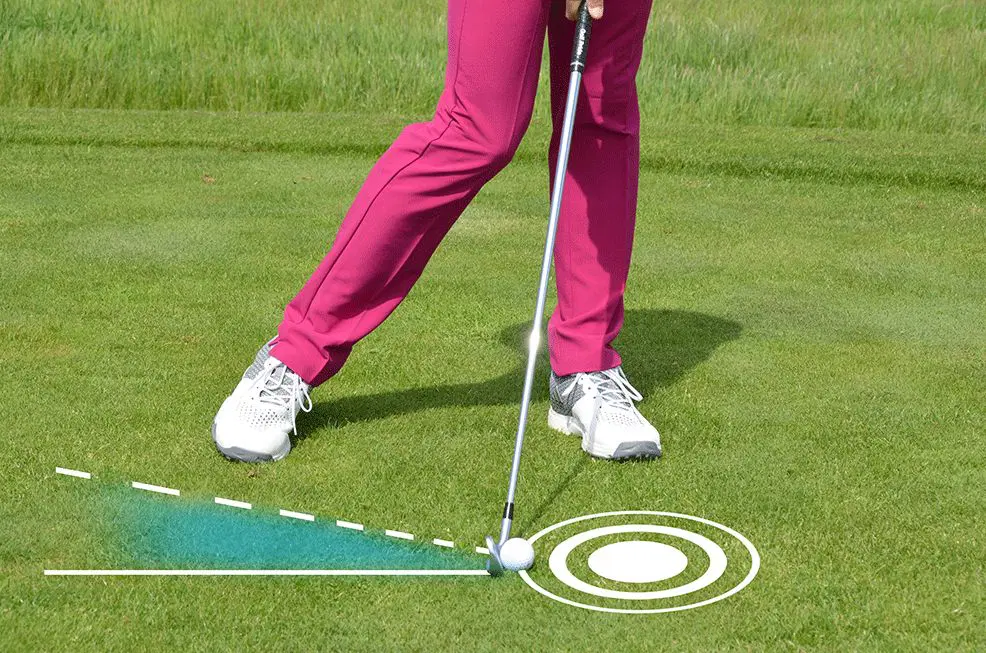
When beginning the downswing, our goal should be to move the body laterally towards the target and rotate so that most of the weight is on the lead leg during impact. As shown in the image, the entirety of my lead side is well aligned. This position assists the golf club in descending to the lowest position just after hitting the golf ball. If you can see space between the line and your body, then you are considered to be “hanging back”, which makes it very difficult to achieve the proper ball-then-turf strike.
In Golf, when starting your downswing, it is important to move laterally toward the target while rotating the body as well. This change makes it possible to have a good impact position where most of the weight should ideally sit on the lead leg. This ensures that the movement is powerful and precise. As you can interpret from the picture provided, having a straight line with your lead side and center allows you to make any club stroke into the ground right after striking the golf ball.
If, on the other hand, you notice that you are “hanging back”—that is, if there is daylight between the ideal position and the line indicating where you should be—then you are most likely compromising your efficiency within the golf swing. This deficiency not only impacts your ability to make good contact, but also impacts your probability of that desirable ball-and-turf strike. This is important in both distance as well as accuracy. Striving for that connection and prioritizing a shift sideways toward your target with a complete turn will remedy bad habits and strengthen performance on the course.

To continuously hit the ball with precision that comes from a clean strike, focusing on improving one’s iron play is crucial. Luckily for you, the iron is a club that’s mastered through sequential steps that sharpen both one’s technique and provide a structure for future advancement. I proudly present to you the **Pure Your Irons Blueprint**: an uncomplicated, five-part system aimed at improving one’s control of the iron, and therefore, lower their score. With the blueprint in hand, you will understand what you need to change in your swing mechanics to achieve the consistency required to deliver a powerful strike.
Every aspect of the Pure Your Irons Blueprint method focuses on the most important parts of your iron play—grip, stance, alignment, and follow-through. Following this method will help you achieve a more cohesive and confident game. Picture stepping onto the course knowing every single swing is backed by a detailed plan—this is the transformation that awaits. With some dedication and practice, you’ll notice improvements in your striking as well as your performance, making achieving those lower scores not just a goal, but a reality. So why hesitate? Get started today with the Pure Your Irons Blueprint and elevate your game!